
Batter and breading are not two names for the same powder. They attach to the product by different mechanisms, they fail in different ways, and they commit you to different equipment. This guide sets out what each one does, how to write a specification that a supplier can actually meet, and how to test a coating before you put it on a production line.
Shandong Yushengji Food Co., Ltd. · Export Operations · Technical guide | October 2026 | 10 min read
Contents
- Executive summary
- 01 What each powder actually does
- 02 The four failure modes, and what each one tells you
- 03 How to write a coating specification a supplier can meet
- 04 Set points that decide whether the coating works
- 05 How to test a coating before you commit
- 06 When to customise instead of picking a stock product
- 07 What you can verify before you order
- Frequently asked questions
- About the manufacturer
Executive summary
Short answer. Use a batter powder when you want a thin, continuous, sealed shell that stays tight against the meat — karaage, tempura, Korean-style thin-coated chicken, crispy pork strips. A batter powder is mixed with water into a slurry and the product is dipped into it.
Use a breading powder when you want a raised, craggy, flaky shell with visible texture — American-style fried chicken, chicken steak, popcorn chicken, fish fillets. Breading is a dry powder applied to a surface that has already been moistened, usually by a batter.
The distinction is not academic. A batter powder used as a dry breading will not build a crust, because the starch never gets the water it needs to gelatinise into a film. A breading powder mixed into a slurry will produce a shell that is thin, pale and soft, because the particles were designed to swell and flare outward, not to form a continuous film. Both mistakes show up as the same complaint from the customer: the coating does not stay on, or it goes soft too quickly.
Most industrial fried chicken lines do not choose one or the other. They run three stages: a pre-dust, a batter that acts as the adhesive, and a breading that builds the texture. What you are really specifying is that three-stage system, not a single bag of powder. The rest of this article is about how to specify it so that it behaves the same way on Tuesday as it did in the sample kitchen.
01What each powder actually does
The two products work through different physical mechanisms, and that is the whole reason they cannot be swapped.
Batter: gelatinisation into a film
A batter powder is a blend of starch, flour, protein and often a gum or a leavening system, milled so that it hydrates quickly and evenly. When you mix it with water, the starch granules absorb water and swell. When the coated product hits hot oil, those swollen granules gelatinise and fuse into a continuous film, and the protein fraction sets alongside it. The result is a shell that is sealed: it holds moisture in and oil out, and it stays smooth rather than craggy.
Everything that matters about a batter follows from that: how much water the starch takes up (the water-to-powder ratio), how viscous the slurry becomes and how fast (measured as a flow time or as peak viscosity on a Rapid Visco Analyser), and how long the slurry can stand before it starts to separate or to hydrate into a lumpy mass. Those three things are what you should be asking a supplier to declare, not just a flavour name.
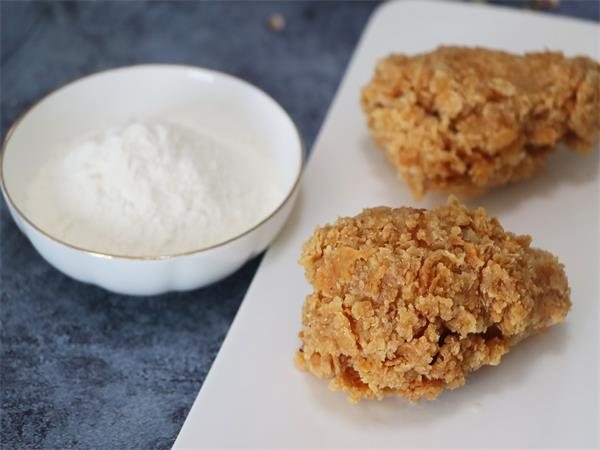
A batter-type coating powder alongside finished fried chicken. The shell is continuous rather than flaky — that is the visual signature of a batter system.
Breading: a three-layer build
A breading powder is a dry, coarser material — flour, starch, crumb, seasoning — that is pressed onto a moist surface. It does not form a film. It forms a stack, and the stack has to be built in the right order:
| Layer | What it is | What it does | What happens if you skip it |
| 1. Pre-dust | Fine dry flour or starch | Absorbs surface moisture so the batter can grip; creates a key between meat and batter | Batter slides off the protein; shell separates in the fryer or after freezing |
| 2. Batter | Slurry, usually a thin one | Acts as the adhesive that carries the outer crumb; provides the continuous under-layer | Dry breading will not adhere to bare meat; coating falls away in patches |
| 3. Breading | Coarse flour, crumb or flake | Builds the raised, irregular surface that reads as “crispy”; creates the air pockets that stay crunchy | Shell is thin and smooth — visually flat, and it softens faster |
The layering explains a complaint we hear constantly: “the coating looked right in the sample kitchen but falls off on our line”. In most cases the breading itself is fine and the pre-dust stage is missing, applied too thinly, or defeated by a product surface that is too wet. A breading cannot compensate for a missing foundation.
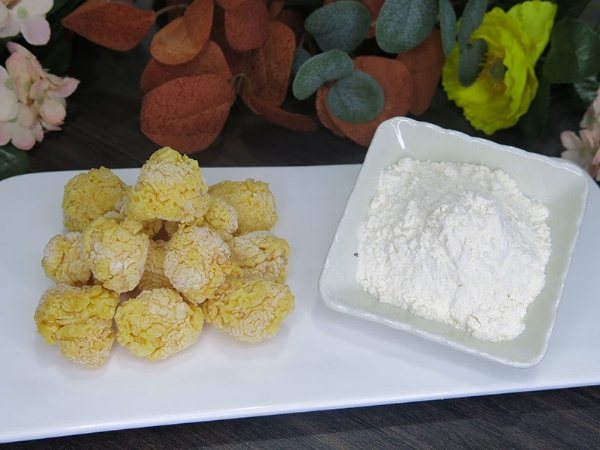
Popcorn chicken with its breading powder. The raised, granular surface comes from particles swelling and flaring outward during the fry — a breading effect, not a batter effect.
02The four failure modes, and what each one tells you
Coating problems are usually diagnosed by looking at the failure rather than at the powder. Each of the four common failures points at a specific stage.
1. Shell separation (the coating slides off in one piece)
This is almost always a pre-dust or surface-moisture problem, not a powder problem. The product surface was too wet for the batter to key into, or the pre-dust was too coarse and left bare patches. It also appears when batter viscosity is too low, so the film is thin and weak at the interface. Check in this order: surface dryness after portioning, pre-dust coverage, then batter flow time.
2. Thick, soft, bready shell
Batter too viscous, or too much of it picked up on the dip. A thick film traps water and produces a doughy layer that never fully crisps, and it insulates the product so the core cooks slower. On a continuous line this is often a drain-time problem rather than a formula problem — the product leaves the batter bath with too much liquor still clinging to it.
3. Flat shell with no flake or craggy texture
The breading particles are too fine, or the breading was pressed onto the product so firmly that the particles packed together and could not flare. It also happens when the batter underneath has already dried before the breading is applied: dry batter cannot bond to dry powder, so you get a dusting rather than a crust.
4. High oil pickup and fast softening after freezing
Usually a combination of an over-thick shell and an under-cooked fry. A thick shell holds oil in its outer layers; when the product is later reheated, that oil migrates inward and the shell loses its crispness quickly. This is the failure that most often gets blamed on the powder and is actually a set-point problem at the fryer.
A note on percentages
Every article on coating claims a percentage improvement. We do not, because oil pickup and coating pickup depend on your product geometry, your batter solids, your fryer load and your oil turnover. The honest answer is that you measure it on your own line, twice, with the same protocol, before and after a change. Any supplier who quotes you a number without seeing your line is guessing.
03How to write a coating specification a supplier can meet
A purchase order that says “crispy coating powder” is not a specification. These are the parameters that actually determine behaviour on a line, and that a competent supplier should be able to declare and to hold batch to batch.
| Parameter | Why it matters | Batter powder | Breading powder |
| Moisture | Shelf stability and dosing accuracy | Typically declared and controlled tightly; excess moisture causes caking and variable hydration | Same, plus it changes how much the particle swells in the fryer |
| Particle size | Hydration speed, texture, dusting behaviour | Fine and uniform; coarse particles hydrate unevenly and leave lumps | Deliberately graded; the coarse fraction is what creates the visible flake |
| Peak viscosity / flow time | The single best predictor of film thickness and pickup | Critical. Ask for a flow time at a stated solids level and temperature | Less relevant as a slurry; relevant only for the batter layer beneath it |
| Water absorption | How much liquor the powder takes at a given ratio | Determines the practical water range you can run without changing texture | Determines how fast the outer layer hydrates and sets |
| Protein content | Browning, structure, and adhesion | Contributes to film strength and colour development | Contributes to crust colour and to how the crumb browns |
| Colour and appearance | Colour consistency of the finished product | Should be declared as a range, not a single value | Same; natural ingredients vary seasonally and a range is honest |
Two practical notes. First, ask for the viscosity or flow time at the solids level you will actually run, not at a nominal one — a supplier quoting a flow time at a concentration you never use has told you nothing. Second, ask for the specification as a range with a stated test method. A single number with no method is not a specification and cannot be enforced in a claim.
04Set points that decide whether the coating works
The powder only does half the work. These are the parameters we control on our own lines and the ones we ask a customer to establish before a trial, because a coating that is correct in the bag will still fail at the wrong set points.
| Step | Operation and set points |
| 1 | Portion and surface prep Cut, trim, portion. Surface must be evenly moist but not wet — standing water defeats pre-dust. Target: no free liquid on the surface |
| 2 | Pre-dust Fine dry powder, applied by dusting or tumbling. Cover fully, then shake off the excess. Excess pre-dust turns into a paste in the batter |
| 3 | Batter dip Slurry held cold. Agitate gently to keep solids in suspension. Control dwell and drain time. Batter 0–4 °C; drain until the flow breaks into drips |
| 4 | Breading Apply coarse powder by hand or by breading machine. Press lightly only if the product needs a flatter profile. Do not compact; compaction kills the flake |
| 5 | Rest before fry Short rest lets the outer layer hydrate and bond. Too long and the coating turns pasty. Typically a few minutes, set by trial on your line |
| 6 | Fry Oil temperature and load control the shell set and the oil pickup. Common window 170–180 °C; do not overload the basket |
| 7 | Freeze Freeze fast enough that ice crystals stay small, or the shell is damaged from inside. −28 to −30 °C to a core of −18 °C |
The rest stage in step 5 is the one most often skipped in a pilot and most often responsible for a coating that behaves differently on the line than it did in the kitchen. A coating that goes straight from breading to fryer has not had time to bond, and it will shed in the oil.
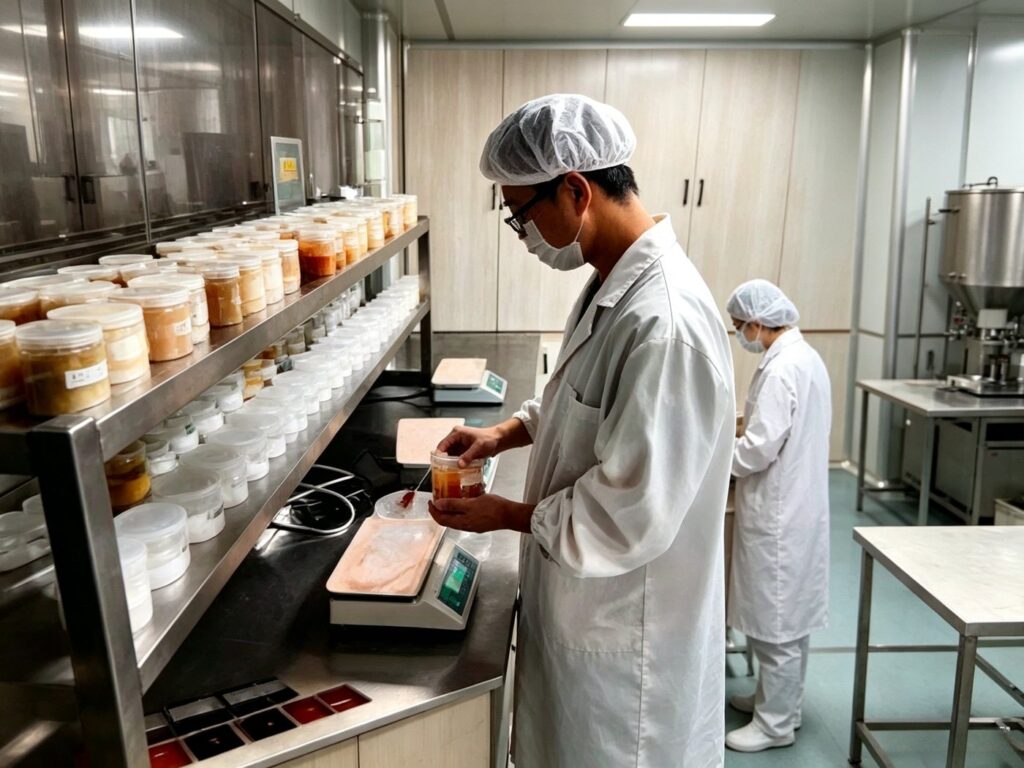
An operator working a heated vessel in the Zhucheng plant. Set points matter more than the powder on this kind of line — temperature, dwell and load decide the result.
05How to test a coating before you commit
A coating trial that only answers “does it taste right” has not tested the coating. These are the checks that predict whether a system will survive freezing, storage and reheating — the conditions under which most coatings actually fail.
| Test | Method | What a pass looks like | When to run it |
| Coating pickup | Weigh bare product and coated product on the same scale | A stable pickup within your declared tolerance across three consecutive batches | Every trial; it is the cheapest predictor of cost per unit |
| Adhesion, raw | Gentle handling and a visual check after the rest stage | No bare patches, no lifting at the edges | Every trial |
| Adhesion, after freeze | Freeze, hold, thaw per your normal handling, then inspect | Shell intact after the freeze–thaw cycle | Before any specification is signed |
| Oil pickup | Weigh before and after the fry with controlled drain time | Within the range you set for the product; compare like for like | Every trial, with the same oil and the same load |
| Reheat performance | Reheat by the method your customer will use — fryer, oven, air fryer | Shell still reads as crisp at the point of consumption, not just out of the fryer | Every trial; this is where most coatings fail |
| Yield / cook loss | Weigh before and after cooking | Within your cost model for the product | Every trial |
Run the reheat test with the customer’s actual method. A coating that is excellent from a fresh fryer and poor after 20 minutes in a holding cabinet is not a good coating for a delivery or QSR account, no matter how it scored in the first minute.
06When to customise instead of picking a stock product
Our catalogue carries 88 product entries across 137 SKU codes, and a large share of what we ship is still a stock formulation. Customising is the right answer in a narrower set of cases than most buyers assume.
- The product geometry is unusual. Whole-muscle with skin, bone-in pieces, or a shaped product with thin edges — the thin edges set first and burn while the thick centre is still raw. A stock coating rarely covers that spread.
- The cooking method is not a fryer. Air-fry, oven-bake and steam-reheat all change the water available at the surface. Coatings designed for immersion frying behave differently when the heat transfer is by air.
- The product will be boiled or held in sauce. “Resistant to boiling” is a real and separate requirement; a standard batter will slough off in a braise.
- Oil pickup is a specification, not a preference. If a customer has set a fat target on the label, the coating has to be formulated against it.
- There is a compliance constraint. Halal, allergen declaration, or a market that restricts a particular additive — these change the formula, not the process.
- Your line has a constraint you cannot change. A breading machine with a fixed roller gap, a fryer with limited dwell, or a freezer with limited pull-down all narrow the formulation window.
Conversely, if you are making a conventional bone-in fried chicken on a conventional line for a market without a specific claim, a stock product is usually the faster and cheaper route. Customising for its own sake adds trial cycles without adding value.
07What you can verify before you order
Coating performance is a claim, and claims should be checkable. These are the certificates we hold and the numbers on them, so that a buyer can verify rather than take on trust.
| Certification | Scope and certificate number |
| ISO 22000 | Food safety management system — certificate 001FSMS2300493 |
| HACCP | Hazard analysis and critical control points — certificate 001HACCP2300562 |
| BRCGS | Global food safety standard — certificate 10010964 |
| IFS | International Featured Standards, food — certificate 92957 |
| US FDA | Facility registration — 12585845698 |
| Halal | Halal certification — 7244240000 |
| Production licence | SC10337078209622 |
| Export filing | Registration 4000/17071 |
Certificates have validity dates. If a certificate matters to your audit, ask for the current copy and check the expiry date against your shipment date rather than relying on a number printed in a brochure.
The plant itself is also checkable: 21,000 m2 in Zhucheng, 30+ production lines, 50,000 t of annual capacity, more than 20 R&D specialists, and a Qingdao R&D centre that opened in July 2024. If you are placing a first order, ask for a live video walk-through of the coating line rather than a photo set.
Frequently asked questions
| Question | Answer |
| Is batter powder the same as breading powder? | No. A batter powder is mixed with water into a slurry and forms a continuous film when fried. A breading powder is applied dry to a moistened surface and forms a raised, flaky layer. They are formulated for different mechanisms and are not interchangeable. |
| Can one powder do both jobs? | Poorly. Some blends will hydrate into a slurry and also adhere as a dry dusting, but the particle size and starch blend that make a good film are not the ones that make a good flake. If you need both textures, use two products. |
| Why does my coating fall off after freezing? | Usually because the shell was damaged during freezing, or because adhesion was marginal to begin with and the freeze–thaw cycle finished it off. Check pre-dust coverage and batter viscosity first, then check that your freezer pulls the core down fast enough to keep ice crystals small. |
| What is pre-dust for, and can I skip it? | Pre-dust absorbs surface moisture so the batter can key into the protein. Skip it and the batter sits on a layer of water and slides off. It is the cheapest stage in the process and the one most often omitted in pilots. |
| Should I choose a thin batter or a three-stage system? | Choose a thin batter when you want a tight, sealed shell and a clean bite — karaage, tempura, thin Korean-style coating. Choose three-stage when you want visible texture and a longer hold time under a heat lamp or in a delivery box. |
| What is the difference between a batter mix and tempura flour? | Tempura flour is a type of batter powder formulated for a light, lacy shell and a short hold time; it is usually run at a lower solids level and often with cold water and minimal mixing. A general-purpose batter powder is formulated for a stronger film and a wider process window. Both are batters; they are not the same specification. |
Send us your product and your line
Tell us what you make, the volume you run and the market you ship to. We will come back with a formulation direction and a trial proposal, including the parameters we would want to measure on your equipment before anyone commits to a specification.
Contact the export operations team at Shandong Yushengji Food Co., Ltd. to arrange a sample and a trial proposal.
About the manufacturer
Shandong Yushengji Food Co., Ltd. formulates and manufactures customised compound seasoning for fried and prepared food: marinade, batter and breading, sauce, sprinkle and functional ingredients. The Zhucheng plant covers 21,000 m2 with 30+ production lines, 50,000 t annual capacity and more than 20 R&D specialists; a Qingdao R&D centre opened in July 2024.
Certificate numbers: ISO 22000 (001FSMS2300493) · HACCP (001HACCP2300562) · BRC (10010964) · IFS (92957) · US FDA (12585845698) · Halal (7244240000) · production licence (SC10337078209622) · export filing (4000/17071).
Technical figures in this article trace to our product manual, our own certificates or the process set points we run in production. Where an outcome depends on your raw material, equipment or line, the article says so and we measure it on your line instead of quoting a number from ours.