
Changing a seasoning supplier is not a purchasing event. It is a product change that your customers will detect if it is handled casually. This is a staged transition method that keeps the brand protected while the supply base changes underneath it.
Contents
II. The five-stage transition method
III. What to compare, and how to score it
IV. The five most common causes of a failed transition
V. When a straight match is not possible
VI. How this works in practice
| SHORT ANSWER The switch succeeds or fails on one thing: whether you defined a measurable baseline before you started. “The same taste” is not a specification. Colour after marination, cooked yield, texture after freeze–thaw, and flavour intensity at your usage ratio are specifications. Run the transition in five stages — baseline, match, trial, parallel run, cutover — and keep the incumbent supply alive until the new product has survived a full production cycle and a freeze–thaw round. |
I. Why supplier switches fail
A buyer finds a supplier quoting a lower price, requests a sample, tastes it, approves it, and places the first production order. Three weeks later, service complaints rise: the colour is slightly different, the product looks smaller, the crust behaves differently after the customer reheats it. By then the incumbent supplier has been stood down and the leverage to go back is gone.
The failure is not usually in the new supplier’s product. It is in the process used to evaluate it. Three specific mistakes account for most of these failures.
Mistake 1: The baseline was never written down
If you cannot state — in numbers — what your current product’s colour, yield, texture and pH look like, you have no way to judge whether a replacement matches. Taste memory is unreliable, and it is biased toward noticing change rather than absence of change.
Mistake 2: The trial ran on the wrong chicken
A sample evaluated in a laboratory pan, on chicken supplied by the seasoning company, tells you very little about performance on your line, on your raw material, at your scale. Most formulation failures appear at scale-up, not at tasting.
Mistake 3: The switch was a step change, not a ramp
Cutting from 100% incumbent to 100% new supplier in one production day concentrates all the risk into a single shift. Any problem becomes a customer-visible event rather than a controllable deviation.
II. The five-stage transition method
Stage 1 — Establish the baseline (before contacting any new supplier)
Measure your current product and write the numbers down. At minimum: colour after marination and after cooking, cooked yield percentage with a fixed drain protocol, purge volume after freeze–thaw, texture notes after reheating, and flavour intensity at your actual usage ratio. Keep two sealed retained samples of the incumbent product from the same batch.
This is the stage most buyers skip, and it is the one that makes everything else possible. Without it, you will be arguing about taste instead of comparing data — and the incumbent always wins an argument about taste because nobody can prove anything.
Stage 2 — Brief the new supplier with your baseline, not with adjectives
Send the new supplier your written baseline and a sample of the incumbent product. Ask them to match it, and to state explicitly which parameters they will match and which they cannot. A supplier who claims to match everything without qualification is not being informative.
Ask for the recommended usage ratio and process parameters in writing at the same time. If the new product needs a different usage ratio or a different marination regime, that is a cost and a process change — find out now, not at cutover.
Stage 3 — Trial on your own line, in your own kitchen
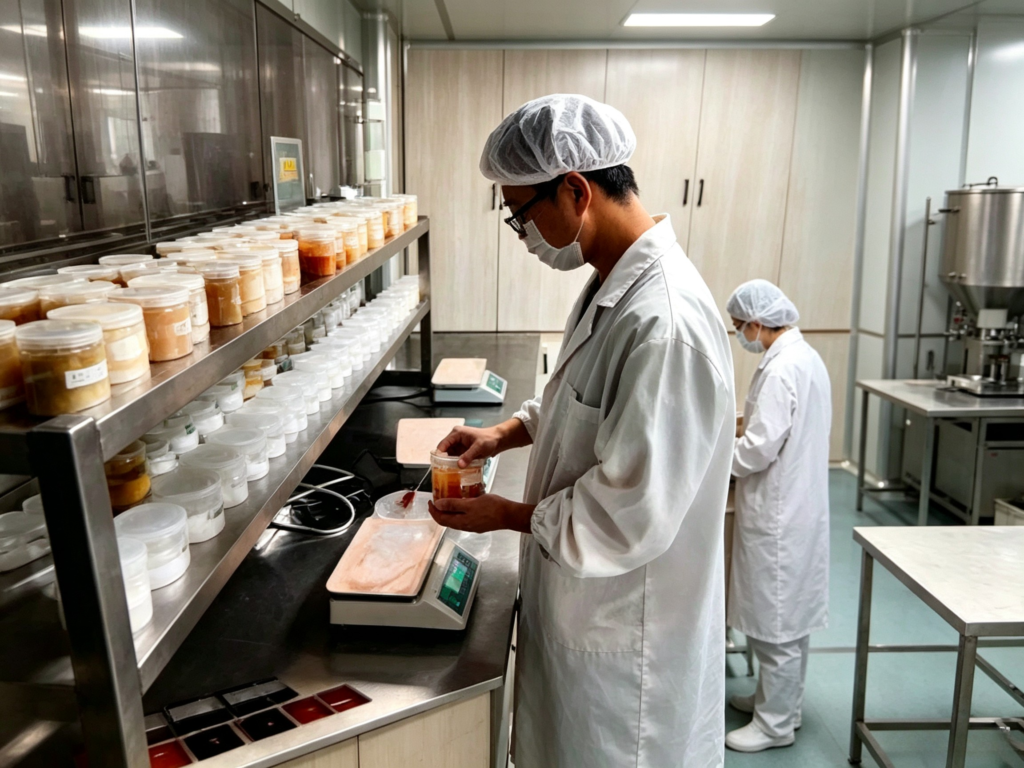
Run the new product and the incumbent side by side, on the same batch of chicken, with the same equipment and the same process parameters. Measure the same five baseline points. Record the results in a comparison table rather than a narrative.
Include a freeze–thaw cycle in this trial. If you only test fresh, you will not see the purge and texture differences that your customers will see weeks later.
Stage 4 — Parallel run on part of your volume
Allocate a portion of production — one line, one shift, or one lower-risk account — to the new product while the incumbent continues on the rest. This de-risks the change and gives you real production data over multiple batches, which is the only way to see batch-to-batch variance.
Run this stage long enough to cover at least one raw-material delivery cycle and one full freeze–thaw round trip. If your product reaches the customer frozen, the parallel run is not complete until a frozen shipment has been thawed and evaluated.
Stage 5 — Cut over, with the incumbent still available
Complete the switch on the remaining volume, but hold the incumbent relationship open for a defined period — long enough to cover a full production and distribution cycle. Only close it when the new product has been through the system with no deviations in the baseline parameters.
Keep the baseline record and the retention samples. They are your reference for every future batch dispute.
The stage people skip — and regret. Stage 4, the parallel run. Buyers who move straight from a successful trial to a full cutover lose the ability to compare, and they lose the incumbent as a fallback. The parallel run costs you the complexity of running two supply streams for a few weeks. It buys you the option to reverse a decision cheaply.
III. What to compare, and how to score it
| Parameter | Measurement | Why it decides the switch |
| Colour after marination | Visual against retained sample, same lighting | Colour drift is the earliest signal a customer notices, especially on retail-facing product. |
| Colour after cooking | Visual against retained sample | Some formulations match raw and diverge on cooking because of how the spices and sugars react to heat. |
| Cooked yield | Percentage, fixed drain protocol | Determines your cost per finished kilogram and your portion consistency. |
| Purge after freeze–thaw | Volume or weight of liquid released | A leading cause of “the product looks smaller” complaints, and invisible if you only test fresh. |
| Texture after reheating | Structured comparison notes | Determines whether the customer’s end experience matches what they bought last time. |
| Flavour intensity at your usage ratio | Comparison at the ratio you actually use | Guards against a product that tastes right at the supplier’s suggested dosage but differently at yours. |
| Batch-to-batch variance | Spread across at least three production batches | Reliability matters more than a single perfect sample. |
| Process compatibility | Written parameters vs your line capability | A different tumbling time or marination hold changes your capacity and your schedule. |
IV. The five most common causes of a failed transition
- No written baseline. Without it, every comparison is an opinion, and differences are discovered by customers rather than by your QA team.
- Trial run on the supplier’s chicken. Performance on someone else’s raw material does not transfer to yours.
- No freeze–thaw in the trial. The most common divergence appears after freezing, and a fresh-only trial will not reveal it.
- Usage ratio changed without recosting. A product that needs 7% instead of 5% can be more expensive than the incumbent even at a lower price per kilogram.
- Certification scope not re-verified. If you export, a new supplier’s Halal scheme, or a gap in it, can halt the shipment regardless of how well the product performs.
V. When a straight match is not possible
Sometimes the incumbent product cannot be matched exactly — because the formulation is protected, because an ingredient is unavailable, or because the new supplier’s platform is fundamentally different. In that case you have three options, in order of preference:
Match the functional performance, then tune the flavour. Hold the yield, texture and process behaviour constant, and adjust the flavour system to land on the target profile. Functional performance is harder to change later than flavour is.
Match the flavour, and accept a process change. If the new product requires a different marination regime, model the impact on your capacity and schedule before agreeing. A process change that costs you throughput is a cost, not an optimisation.
Run two products in parallel permanently. For some product lines, a controlled dual-source arrangement is the right answer — it protects you against supply interruption and keeps both suppliers honest on price. It requires that you can verify both products against the same baseline.
A note on compliance continuity. If you export, treat certification as part of the transition, not a separate task. Verify the new supplier’s certificate scope — facility, product category, validity — and whether that scheme is recognised in your destination market. Indonesia’s BPJPH Halal requirement has applied in full since 17 October 2026, and Malaysia’s JAKIM scheme carries broad recognition across ASEAN and the Middle East. A gap here stops a shipment faster than any quality issue.
VI. How this works in practice
Yushengji Food Ingredients is a compound seasoning and marinade manufacturer in Shandong, China, supplying chicken marinades, coating powders and batters, sprinkle-on seasonings, sauces and functional ingredients to food factories in Indonesia, Malaysia and the UK. A significant share of our customer relationships begin as a second-source qualification or an incumbent replacement, so the staged method described above is close to how we work by default.
In practice that means we ask for the current product as a reference and a written baseline, then run the trial on the customer’s own raw material and equipment rather than presenting a laboratory sample. Our reference marination process for reconstituted chicken — chicken base 100, marinade 5–7, functional moisture-retention compound 0.3, acidity regulator 0.3, corn starch 5–8, ice water 10–15, vacuum tumbling at −0.08 MPa for 50–80 minutes, marination at 0–4 °C for 8 hours or more, then blast freezing at −28 to −30 °C to a core temperature of −18 °C — gives a defined set of parameters to compare against your existing process rather than a rule of thumb.
Our R&D team of more than 20 people handles OEM, ODM and flavour customisation, and our facility runs an annual single-shift capacity of 50,000 tonnes with 5,000 m² of warehousing. We hold HACCP, ISO and Halal system certifications with adaptation support for MUI, JAKIM and BPJPH schemes.
Frequently asked questions
Can I switch seasoning suppliers without customers noticing?
Yes, if you defined a measurable baseline beforehand and validated the replacement against it, including after a freeze–thaw cycle. The failures that customers notice are almost always failures of the evaluation process, not of the new product.
How long should a supplier transition take?
Long enough to run a parallel stage across at least three production batches and one full freeze–thaw and distribution round. Compressing the timeline is possible, but the stages you skip are the ones that carry the risk.
What should I send a new supplier as a brief?
A retained sample of your current product, a written baseline of the measurable parameters — colour, yield, purge, texture, flavour intensity at your usage ratio — and your actual process parameters. Adjectives like “sweeter” or “more traditional” are not a brief.
Should I test the new product on my own chicken or the supplier’s?
Yours, always. Your raw material’s pH, age and chill state affect how a marinade performs. A product validated on the supplier’s chicken tells you how it behaves on their chicken.
Why is freeze–thaw testing essential in a supplier switch?
Because it is where the differences that customers actually experience appear — purge on thawing, colour shift, texture change on reheating. A fresh-only trial validates the wrong scenario.
What if the new supplier’s product needs a different usage ratio?
Recost it before deciding. Compare cost per finished kilogram, not price per kilogram of seasoning. A cheaper product used at a higher ratio may be more expensive in total.
Do I need to re-verify Halal certification when changing suppliers?
Yes. Certification attaches to a facility and a scheme, not to a product category in general. Confirm the issuing body, the facility address, the product scope and the certificate’s validity, and confirm the scheme is accepted in your destination market. Indonesia’s BPJPH requirement has been fully in force since 17 October 2026.
Should I keep my old supplier after the switch?
For a defined period, yes. Keeping the incumbent relationship open until the new product has completed a full production and distribution cycle preserves your fallback. Closing it immediately converts a controllable problem into a supply interruption.
Can I dual-source the same product permanently?
Yes, and for some product lines it is the better structure. It protects against interruption and maintains price tension. It requires that both products can be verified against the same written baseline, which is only possible if you established one.
What is the biggest hidden cost in a supplier switch?
Process changes that are discovered late. A new product requiring a different marination hold time, tumbling regime or usage ratio changes your capacity and your schedule. Surface these in the written parameters at the briefing stage, not during the parallel run.